At Al Khalidi Hospital, quality is embedded in every aspect of patient care and organizational performance. The Quality Improvement Department is responsible for leading the hospital’s efforts in continuous quality improvement, patient safety, risk management, accreditation compliance, and the development and implementation of evidence-based clinical guidelines.
The department works closely with all clinical and non-clinical departments to promote a culture of excellence, accountability, and continuous learning. Through performance measurement, data analysis, quality improvement initiatives, and multidisciplinary collaboration, we ensure that healthcare services are safe, effective, patient-centered, timely, efficient, and equitable.
Key Responsibilities
- Performance Monitoring: Quality improvement and performance monitoring.
- Patient Safety & Risk Management: Programs designed to identify, assess, and mitigate clinical and operational risks to ensure patient and staff safety and support continuous quality improvement. This is implemented using tools such as incident reporting systems, risk registers, root cause analysis (RCA), FMEA, audits, safety rounds, and KPI monitoring.
- Compliance: Accreditation management and regulatory compliance.
- Clinical Metrics: Clinical indicators and outcome measurement.
- Audits: Clinical audit and quality reviews.
- Guidelines: Development and implementation of clinical pathways and guidelines.
- Education: Staff education and quality awareness programs.
- Document Control and Management: Ensuring all policies, procedures, forms and clinical guidelines are systematically developed, approved, updated, and controlled to maintain consistency and compliance.
- Infection Control: Infection prevention and control collaboration.
- Patient Experience: Patient experience and satisfaction improvement initiatives.
Our Commitment
Through quality improvement, accreditation excellence, evidence-based clinical guidelines, and internationally recognized management systems, Al Khalidi Hospital remains committed to delivering exceptional healthcare services that prioritize patient safety, clinical excellence, and continuous improvement.
We believe that quality is everyone’s responsibility, and together we strive to provide the safest and most effective care for our patients and community.
Quality Improvement Projects
Al Khalidi Hospital continuously implements quality improvement projects aimed at enhancing patient safety, improving clinical outcomes, and increasing operational efficiency across all departments. These projects are based on data analysis, incident trends, audit results, and key performance indicators, and are developed through multidisciplinary teamwork to ensure effective and sustainable improvements.
Key areas of projects include:
- Patient safety and reduction of clinical risks and adverse events.
- Medication safety and high-alert medication management.
- Infection prevention and control improvement initiatives.
- Laboratory quality improvement and reduction of reporting errors.
- Patient flow and waiting time reduction in different departments.
- Improvement of documentation accuracy and compliance.
- Enhancement of surgical safety and perioperative processes.
- Strengthening incident reporting and learning systems.
- Improving patient experience and satisfaction scores.
- Waste management and environmental sustainability initiatives.
- Optimization of resource utilization and operational efficiency.
Methodology: Each project follows structured quality improvement methodologies such as Plan-Do-Study-Act (PDSA), Root Cause Analysis (RCA), and Failure Mode and Effects Analysis (FMEA) to ensure measurable and sustainable results.
Accreditations & Certifications
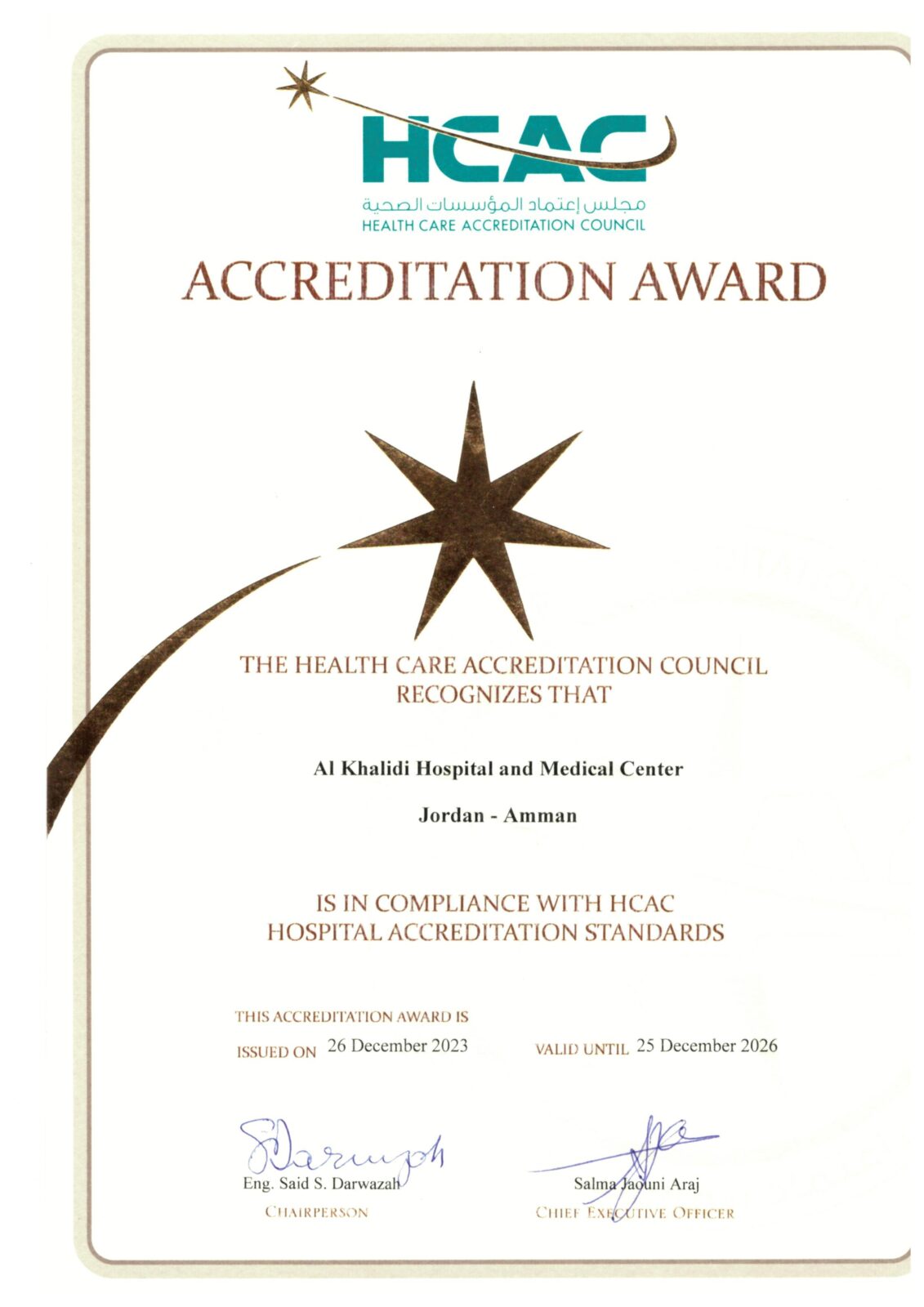
HCAC Accreditation
Al Khalidi Hospital has maintained its commitment to healthcare quality and patient safety through continuous compliance with the standards of the Health Care Accreditation Council (HCAC). Since achieving HCAC accreditation in 2013, the hospital has continuously strengthened its quality systems, patient safety practices, clinical governance, and performance improvement programs to align with national and international healthcare standards.
HCAC accreditation reflects the hospital’s long-standing dedication to delivering safe, effective, compassionate, and patient-centered care while continuously improving healthcare services for patients, families, and the community.
ISO 22000 Food Safety Management System
Al Khalidi Hospital has been certified according to the ISO 22000 Food Safety Management System standard since 2014, demonstrating its commitment to maintaining the highest standards of food safety and quality across all food service operations. This certification reflects the hospital’s dedication to protecting the health and well-being of patients, visitors, employees, and healthcare providers through a comprehensive food safety management framework.
Since obtaining ISO 22000 certification in 2014, Al Khalidi Hospital has continuously enhanced its food safety management practices through:
- Strict food preparation, storage, transportation, and distribution controls.
- Continuous monitoring of food safety hazards and critical control points.
- Compliance with local and international food safety regulations.
- Ongoing staff education and competency development in food safety practices.
- Regular internal audits, inspections, and performance evaluations.
- Continuous improvement initiatives to strengthen food service quality and safety.
The implementation of ISO 22000 supports the hospital’s commitment to providing safe, nutritious, and high-quality meals while maintaining the confidence of patients, visitors, and healthcare professionals. It also reinforces Al Khalidi Hospital’s broader mission of excellence, safety, and quality across all healthcare and support services.
Accreditations